
What is landed cost when importing from China?
When importing products from China, the supplier quotation is only the starting point. Packaging, origin transport, international freight, insurance, customs duties, import taxes, clearance fees, destination charges and final delivery can all change the true cost of the order.
Landed cost is the total relevant cost of purchasing the goods and bringing them to the buyer's required destination. For commercial decision-making, the most useful question is therefore not only “What is the supplier's unit price?” but “What will this product actually cost per unit after the relevant import expenses are included?”
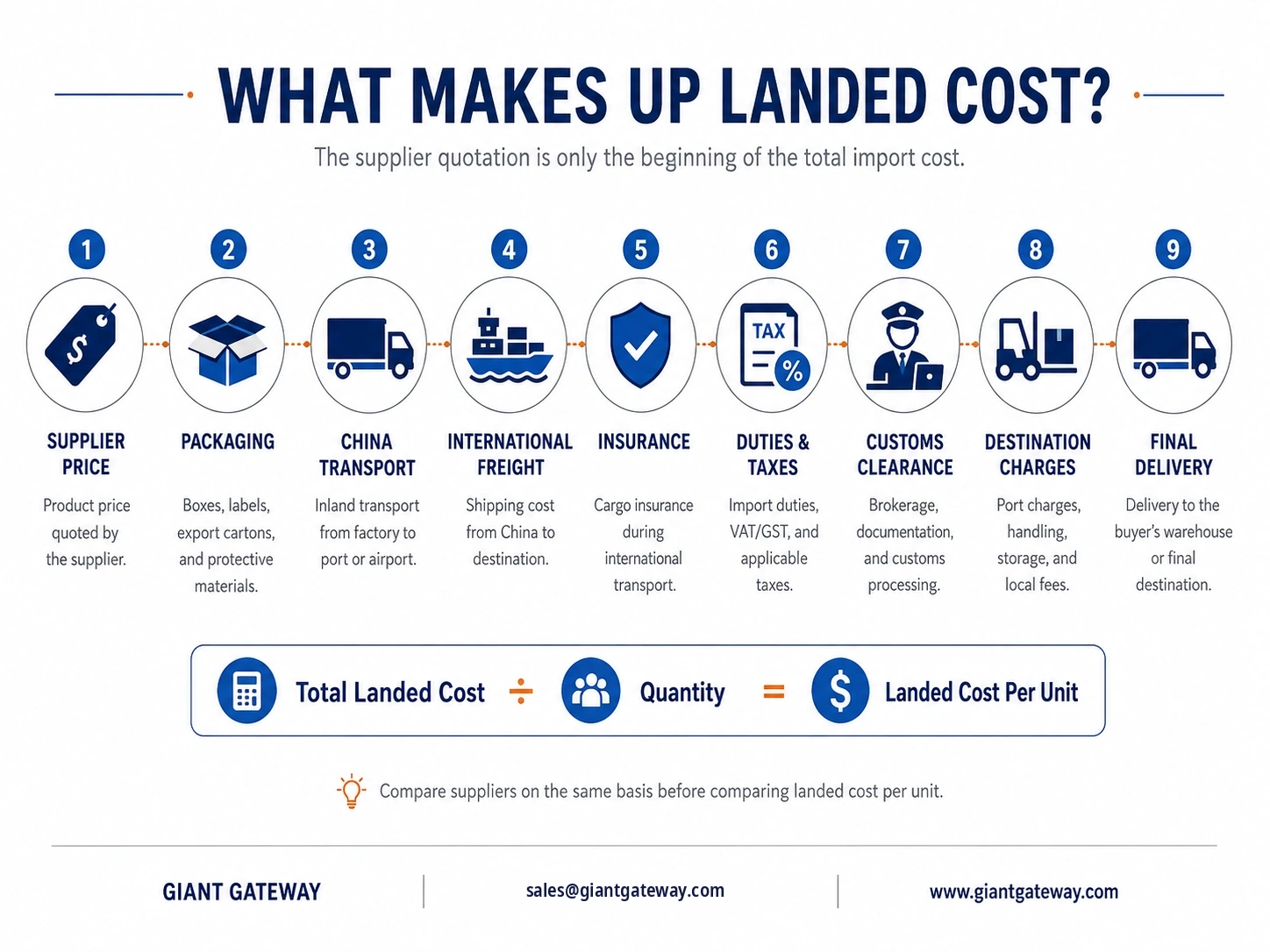
The exact components depend on the Incoterm, product, shipment method, destination country and commercial arrangement. A cost that is already included in one quotation should not be added a second time.
Why landed cost matters when importing from China
A product can look inexpensive at the quotation stage and become much less attractive after transport and import costs are added. Calculating landed cost before confirming an order helps buyers compare offers on a more consistent basis, estimate margins and identify costs that may otherwise appear later in the transaction.
- Compare suppliers using a more realistic total-cost basis instead of unit price alone
- Estimate the actual cost per unit before setting a selling price or target margin
- Identify packaging, freight, customs and destination costs before shipment
- Understand whether an apparently cheaper Incoterm quotation creates additional buyer-side costs
- Plan cash requirements more accurately before production and shipping begin
Landed cost should not be used as the only supplier-selection criterion. Product specification, quality, supplier capability, lead time, warranty and commercial risk still matter. The purpose of the calculation is to make the cost comparison more complete.
Information you need before calculating landed cost
A landed-cost estimate is only as reliable as the information used to build it. Before calculating, collect the commercial, packing, freight and customs information that materially affects the shipment.
| Information | What to confirm |
|---|---|
| Supplier quotation | Unit price, quantity, currency, product specification, customization, packaging and quotation validity |
| Incoterm and named place | EXW, FCA, FOB, CIF, DAP, DDP or another agreed rule, plus the exact named place or port |
| Packing data | Number of cartons, carton dimensions, gross weight, net weight, pallets or crates where relevant |
| Origin | Factory or pickup location in China and the port, airport, rail terminal or consolidation point |
| Destination | Destination country, port or airport, delivery city and final delivery point if known |
| Freight basis | Sea, air, rail, courier or multimodal transport and what the freight quotation includes |
| Customs classification | The appropriate HS classification or the information required to confirm it |
| Import charges | Estimated customs duty, VAT, GST or other destination-country charges where applicable |
| Destination charges | Brokerage, terminal handling, documentation, storage, local delivery and other relevant fees |
What costs are included in landed cost?
Supplier or product cost
Start with the amount charged for the goods. Depending on the project, this can include the unit price, tooling, setup charges, customization, printing, private-label work or other supplier-side costs.
Packaging
Packaging can include retail boxes, labels, inserts, export cartons, protective materials, pallets or crates. Packaging affects landed cost twice: directly through packaging cost and indirectly because carton dimensions and weight influence freight.
Inland transport in China
Goods may need to move from the factory to a forwarder warehouse, consolidation warehouse, seaport, airport or rail terminal. Whether the buyer pays this cost separately depends partly on the agreed Incoterm.
International freight
International freight can be by sea, air, rail, courier or a multimodal route. Buyers should confirm whether the quotation covers only the main transport leg or also includes origin handling, destination fees, customs services or final delivery.
Cargo insurance
Cargo insurance can protect the financial value of a shipment against specified risks during transport. Confirm who arranges the insurance, what value is insured and whether the premium is already included in another quotation.
Customs duties and import taxes
Customs duty and import taxes depend on the destination, customs value, classification, origin and applicable local rules. Buyers should not copy a generic percentage from an unrelated shipment and assume it applies to every product or country.
Customs clearance and brokerage
Customs-processing costs can include brokerage, declarations, documentation and other clearance services. These commercial fees should be distinguished from government duties and taxes.
Destination charges
Depending on the shipment, destination charges can include terminal handling, port or airport fees, local documentation, unloading, warehousing, storage and other local logistics charges.
Final delivery
If the transport quotation ends at the port, airport or forwarder warehouse, the cost of moving the goods to the buyer's warehouse, project site or other final delivery point still needs to be considered.
How to calculate landed cost step by step
Once the major inputs have been collected, organize the calculation in a consistent sequence. The objective is not to create a complicated accounting model; it is to make sure the important costs appear once and in the correct place.
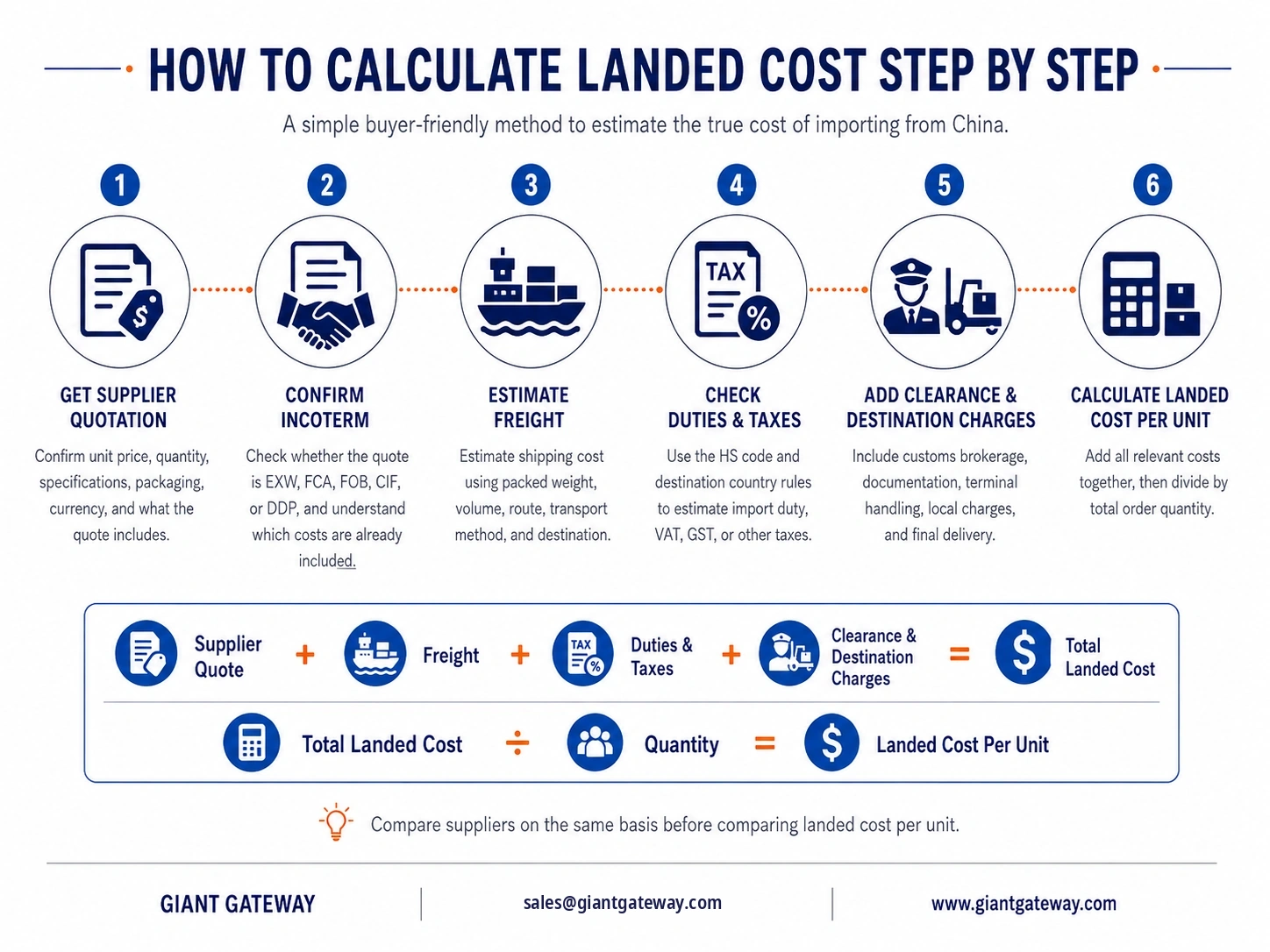
Step 1: Confirm the supplier quotation
Verify the unit price, quantity, currency, product specification, packaging, customization and quotation scope. A quotation such as “USD 6.20 per unit FOB Ningbo” provides a much clearer starting point than a unit price without a delivery basis.
Step 2: Confirm the Incoterm
Identify which costs are already included under the agreed Incoterms® rule and named place. This prevents an EXW, FOB, CIF or DDP quotation from being compared as though each one includes the same logistics responsibilities.
Step 3: Estimate freight
Use the packed carton quantity, gross weight, shipment volume, route and transport method. For bulky goods, volume can be a major cost driver even when the products themselves are lightweight.
Step 4: Confirm classification and estimate import charges
Identify the product classification and investigate the customs treatment that applies at the destination. Where classification or import rules are uncertain, the buyer may need support from a customs broker or other qualified specialist.
Step 5: Add clearance and destination costs
Include customs brokerage, terminal or port charges, documentation, storage where relevant and local delivery if they are not already included in another quotation.
Step 6: Calculate the final cost per unit
Add the relevant cost components to obtain the total landed cost, then divide by the order quantity. This produces the landed cost per unit used for commercial comparison.
Landed cost formula
The most important calculation control is avoiding double-counting. If the supplier's FOB quotation already includes agreed origin-side costs, do not add those same costs again. If a door-to-door freight quotation already includes brokerage or final delivery, separate those amounts only if the forwarder confirms they are additional.
Example: landed cost calculation for an import from China
Consider an illustrative order of 1,000 units. The supplier quotes USD 6.20 per unit FOB and the buyer requires USD 300 of additional branded packaging. The supplier-side cost is therefore USD 6,500 before the remaining import expenses are added.
| Cost item | Illustrative amount |
|---|---|
| Product and custom packaging | USD 6,500 |
| International freight | USD 1,150 |
| Cargo insurance | USD 65 |
| Illustrative import duty | USD 390 |
| Illustrative import tax | USD 810 |
| Customs brokerage | USD 180 |
| Destination charges | USD 260 |
| Local delivery | USD 220 |
| Total landed cost | USD 9,575 |
The original supplier quotation was USD 6.20 per unit, but the broader example produces an estimated landed cost of approximately USD 9.58 per unit. That difference can materially affect resale pricing, gross margin and the commercial viability of the order.
Supplier A vs Supplier B: why the lowest quotation may not be cheapest
Landed cost becomes especially useful when two suppliers appear close on product price but have different packaging, freight or destination costs. The following example uses the same 1,000-unit requirement.
| Cost item | Supplier A | Supplier B |
|---|---|---|
| Product price | USD 6,200 | USD 6,500 |
| Custom packaging | USD 300 | Included |
| International freight | USD 1,150 | USD 850 |
| Cargo insurance | USD 65 | USD 60 |
| Illustrative duties and taxes | USD 1,200 | USD 1,120 |
| Customs brokerage | USD 180 | USD 160 |
| Destination charges | USD 260 | USD 180 |
| Local delivery | USD 220 | USD 190 |
| Total landed cost | USD 9,575 | USD 9,060 |
| Landed cost per unit | USD 9.58 | USD 9.06 |
Supplier A appears cheaper when the product price is viewed alone. Once the broader cost structure is included, Supplier B becomes approximately USD 515 cheaper overall in this illustrative example.
How Incoterms affect landed cost
Incoterms® rules help define important delivery, cost and risk responsibilities between seller and buyer. They do not by themselves calculate landed cost, but they strongly affect which costs are already inside the supplier quotation and which costs the buyer still needs to estimate.
EXW — Ex Works
Under EXW, the seller has a relatively limited delivery obligation at the named place. The buyer may need to add factory pickup, origin transport, export-related handling, international freight, import clearance and destination delivery, depending on the actual arrangement.
FCA — Free Carrier
Under FCA, the seller delivers the goods to the agreed carrier or person at the named place and handles export clearance. FCA can therefore shift more origin-side responsibility to the seller than EXW.
FOB — Free On Board
FOB is intended for sea or inland-waterway transport. The seller delivers the goods on board the vessel at the named port of shipment. The buyer still needs to account for costs beyond that point, including the relevant international freight, import and destination expenses.
CIF — Cost, Insurance and Freight
Under CIF, the seller arranges freight and specified insurance to the named destination port, while risk transfers earlier when the goods are delivered on board at origin. Customs, destination handling and final delivery can still remain outside the quoted amount.
DDP — Delivered Duty Paid
DDP places extensive delivery and import responsibility on the seller up to the named destination. Buyers should still confirm the exact named place, importer arrangements, tax treatment and whether any local service or unloading cost is excluded from the commercial quotation.
Official Incoterms® reference: ICC Incoterms® 2020 rules
Common landed-cost mistakes importers make
- Comparing only the quoted unit price instead of the complete commercial scope
- Comparing EXW, FOB, CIF or DDP quotations as though they include the same responsibilities
- Ignoring carton dimensions, shipment volume or chargeable weight when estimating freight
- Treating the main international freight quotation as a complete door-to-door cost
- Using an unsuitable HS classification or an import-duty assumption copied from another product
- Forgetting customs brokerage, terminal handling, local documentation, storage or final delivery
- Applying a generic tax percentage without checking the destination-country calculation basis
- Adding a cost twice because it is already included in the supplier or forwarder quotation
- Using an old freight rate for an order that will ship much later
- Calculating landed cost once and failing to update it when quantity, packaging or shipment method changes
Customs classification reference: World Customs Organization — What is the Harmonized System?
How to reduce landed cost without sacrificing product quality
Reducing landed cost should focus on unnecessary cost rather than simply pushing the supplier toward a lower material or quality level. The largest savings can sometimes come from shipment design and commercial planning rather than the factory unit price.
- Compare suppliers using equivalent specifications and quotation scope before negotiating price
- Optimize carton dimensions and protective packaging without compromising transit protection
- Choose the transport method according to shipment size, urgency and product value
- Consolidate compatible shipments where consolidation genuinely reduces total logistics cost
- Plan production and shipment early enough to avoid unnecessary urgent air or courier transport
- Confirm duties, taxes and destination charges before the goods are shipped
- Separate one-time development or tooling costs from recurring product cost when comparing repeat orders
A lower landed cost is useful only when the final product still meets the required specification, quality and destination-market requirements.
Buyer checklist before confirming an order
- Product specification and supplier quotation are confirmed
- Quantity, currency, Incoterm and named place are clear
- Packaging cost, carton dimensions, gross weight and shipment volume are available
- Freight estimate is based on the intended route and shipping method
- Customs classification has been reviewed or sufficient product information is available to confirm it
- Estimated duties and taxes have been considered for the destination
- Customs clearance, destination fees and local delivery are included where relevant
- The calculation has been checked for duplicate or missing costs
- The final landed cost per unit has been compared across equivalent supplier offers
If several of these items remain uncertain, keep the figure labelled as an estimate and update it before making a final commercial decision.
How Giant Gateway helps buyers organize import costs
The arithmetic behind landed cost is straightforward. The more difficult part is collecting accurate information from suppliers, packing data, freight arrangements, shipment documents and destination requirements before the order moves too far forward.
Giant Gateway supports international buyers with product request preparation, quotation support, specification comparison, purchase coordination, packaging follow-up, documentation follow-up, quality follow-up and shipment coordination. The objective is to help keep the commercial scope and the information required for cost comparison clearer from quotation through shipment preparation.
Conclusion: compare the real import cost, not only the quotation
When importing from China, the supplier price is only one part of the commercial decision. A useful landed-cost calculation follows the goods from the supplier through packaging, transport, customs and destination delivery so the buyer can estimate the true cost per unit.
The central principle is simple: compare supplier offers on the same product and commercial basis, then compare the estimated landed cost per unit together with quality, lead time, supplier capability and risk. This produces a much stronger purchasing decision than choosing the lowest quoted unit price alone.
Frequently Asked Questions
Landed cost can include the supplier price plus relevant packaging, origin transport, international freight, insurance, customs duties, import taxes, clearance fees, destination charges and final delivery. The exact components depend on the Incoterm and shipment arrangement.
Yes. The relevant transportation costs needed to bring the goods to the required destination should be considered in the landed-cost calculation.
Where customs duty applies to the shipment, it should be considered when estimating the true landed cost.
Applicable import VAT, GST or similar taxes should be considered, although their final accounting treatment can depend on the destination country and the importer's circumstances.
No. An FOB quotation does not normally include the buyer's full international freight, import, destination and final-delivery costs.
Not necessarily. CIF includes specified cost, insurance and freight obligations to the named destination port, but import clearance, duties, destination charges and local delivery may still remain.
DDP can include extensive seller responsibility through import and delivery to the named place, but the buyer should still confirm the exact commercial scope, tax treatment, importer arrangements and any excluded local costs.
Add the relevant costs to obtain the total landed cost, then divide the total by the number of units in the order.
Packaging, shipment volume, factory location, Incoterm, freight, customs treatment, destination fees and included services can all make the final landed cost different even when the product prices are similar.
Planning an import from China?
Send Giant Gateway your product details, quantity, destination, packaging requirements and reference information for product request support, quotation support, purchase coordination and shipment coordination.
Request Your Order