
Why the lowest supplier quotation is not always the best offer
A supplier quotation is not only a price. It is a commercial summary of what the supplier believes the buyer requested: the product specification, material, construction, quantity, packaging, delivery basis, payment terms, lead time, quality controls, documents and service obligations.
Two offers can use the same product name and still describe different products. A lower unit price may result from a different material grade, reduced wall thickness, lower weight, fewer accessories, old stock, less protective packaging, excluded testing or a different delivery term. A reliable quotation comparison therefore begins by asking whether the offers are genuinely equivalent.
The real cases in this guide come from supplier quotations reviewed during Giant Gateway purchasing work. The figures demonstrate the comparison method; they are not presented as universal market prices for every date, country or specification.
Start with one controlled product specification
A professional supplier price comparison is impossible when each supplier receives a different request or fills missing information with different assumptions. Send the same written product requirement to every supplier and require alternatives to be identified separately.
| Comparison area | Requirement to define before comparing prices |
|---|---|
| Product identity | Product name, model, intended application and reference photographs or sample |
| Material and construction | Material type, grade, composition, reinforcement, thickness, weight and approved alternatives |
| Dimensions and tolerance | Nominal dimensions, acceptable tolerance, unit weight or other measurable acceptance criteria |
| Performance | Capacity, pressure, output, strength, finish, operating environment or other product-specific requirements |
| Quantity | Quantity per model, size, colour or configuration; MOQ and price-break quantities |
| Packaging | Unit packaging, inner quantity, carton or bundle details, protection, markings and pallet requirements |
| Compliance and testing | Applicable standard, test report, certificate, label, manual and destination-market requirements |
| Commercial scope | Currency, unit basis, Incoterms® rule, named place, payment terms, lead time, warranty and exclusions |
When the buyer does not know every technical parameter, the request should explain the application, expected result and operating conditions. Suppliers can then recommend clearly labelled options instead of silently changing the product to reach a target price.
Compare materials, grades and product construction—not product names alone
Material terminology is often too broad. “Stainless steel,” “aluminium,” “HDPE,” “cotton,” “wood,” “leather” or “export quality” can each cover several grades, compositions and constructions with different costs and performance.
- Exact material name and grade, including whether approved equivalents are allowed
- Virgin, recycled, blended or reprocessed material where relevant
- Solid, hollow, laminated, coated, reinforced or composite construction
- Thickness, density, weight per unit, coating weight or other measurable material basis
- Principal components, brands or performance classes that affect cost
- Applicable product standard and whether the offered construction falls within it
- Reference sample, drawing or cross-section that defines what the buyer expects
A supplier should not be penalized for quoting a higher-quality or more expensive construction when another supplier has interpreted the request differently. First separate compliant offers, declared alternatives and incomplete offers. Only then compare prices within each group.
Case study: HDPE pipe quotations that were not truly like for like
Five suppliers were asked to quote HDPE pipe. Three offers were grouped at approximately USD 5.00–5.90 per metre, while two offers were much lower at approximately USD 3.50–3.90 per metre. The price gap was large enough to suggest that the suppliers might not be quoting the same construction.
A physical reference sample was requested from the client and cut open. The sample contained an internal metal-mesh reinforcement layer. Follow-up questions then showed that the term “HDPE pipe” had not produced one consistent interpretation: some discussions concerned homogeneous polyethylene pipe, while others concerned a reinforced or composite polyethylene construction.
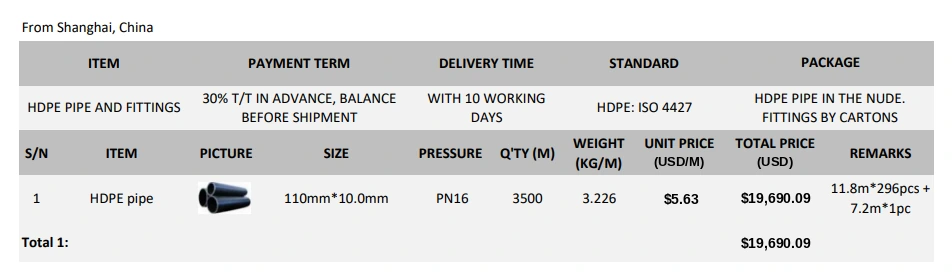
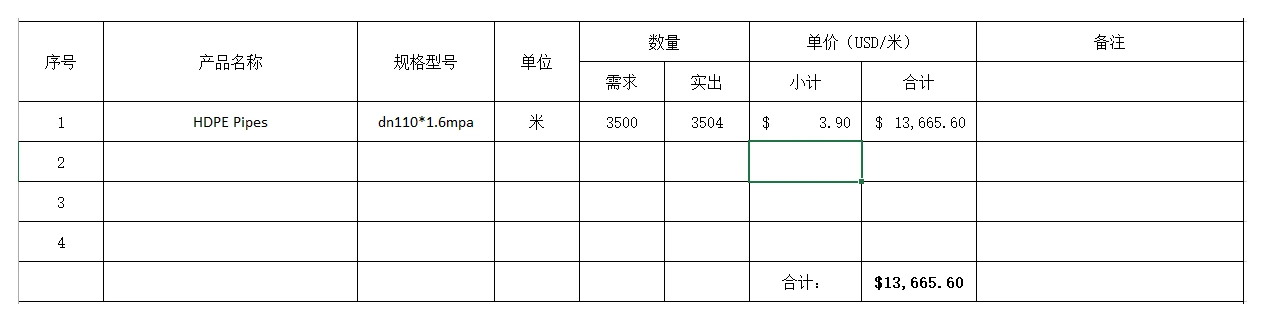
| Visible comparison point | Quotation A | Quotation B | Why clarification was still required |
|---|---|---|---|
| Size or pressure description | 110 mm × 10.0 mm; PN16 | DN110 × 1.6 MPa | Similar pressure wording does not prove identical material or construction |
| Quantity basis | 3,500 m | 3,504 m actual | Totals must be normalized to the same quantity |
| Unit price | USD 5.63/m displayed | USD 3.90/m | The price gap required a technical explanation |
| Weight | 3.226 kg/m shown | Not shown in the visible table | Weight per metre can reveal important construction differences |
| Standard or scope | ISO 4427 stated; fittings packed separately | Tax and freight excluded; construction not fully defined in the visible row | The exact standard, PE grade, reinforcement, fittings and inclusions needed written confirmation |
This case does not establish that pure polyethylene pipe or mesh-reinforced composite pipe is universally better. They are different constructions. The correct option depends on the application, design standard, pressure conditions, joining system and buyer specification.
Technical reference: ISO 4427-2:2019 — Polyethylene pipes for water supply and pressure drainage applications
Check production date, stock age and product condition
An unusually low supplier quotation may relate to existing inventory, overproduction, cancelled orders, discontinued packaging, cosmetic variation or stock that has been stored for an extended period. Existing stock is not automatically defective, but it is not commercially identical to confirmed new production unless the buyer accepts it knowingly.
- Production date, batch number and maximum acceptable stock age
- Indoor or outdoor storage and exposure to moisture, sunlight, dust or chemicals
- Surface condition, corrosion, oxidation, staining, fading, deformation or damaged packaging
- Whether the product still meets the required specification and test criteria
- Whether mixed batches, colours, labels or production dates will be supplied
- Whether the supplier is quoting clearance stock, standard inventory or new production
- Inspection and rejection rights if the disclosed condition is not accurate
The request for quotation should state “new production only” when that is essential. If existing stock may be considered, ask suppliers to quote it as a separate declared option with production date, quantity available, photographs, samples and inspection conditions.
Case study: why a galvanized-wire quotation was USD 5,600 cheaper per container
For BWG 22 galvanized wire, three supplier quotations were received at USD 644, USD 720 and USD 520 per ton. The first two prices formed a practical working comparison range from the offers received. The third quotation was substantially lower, so the supplier was asked directly what created the difference.
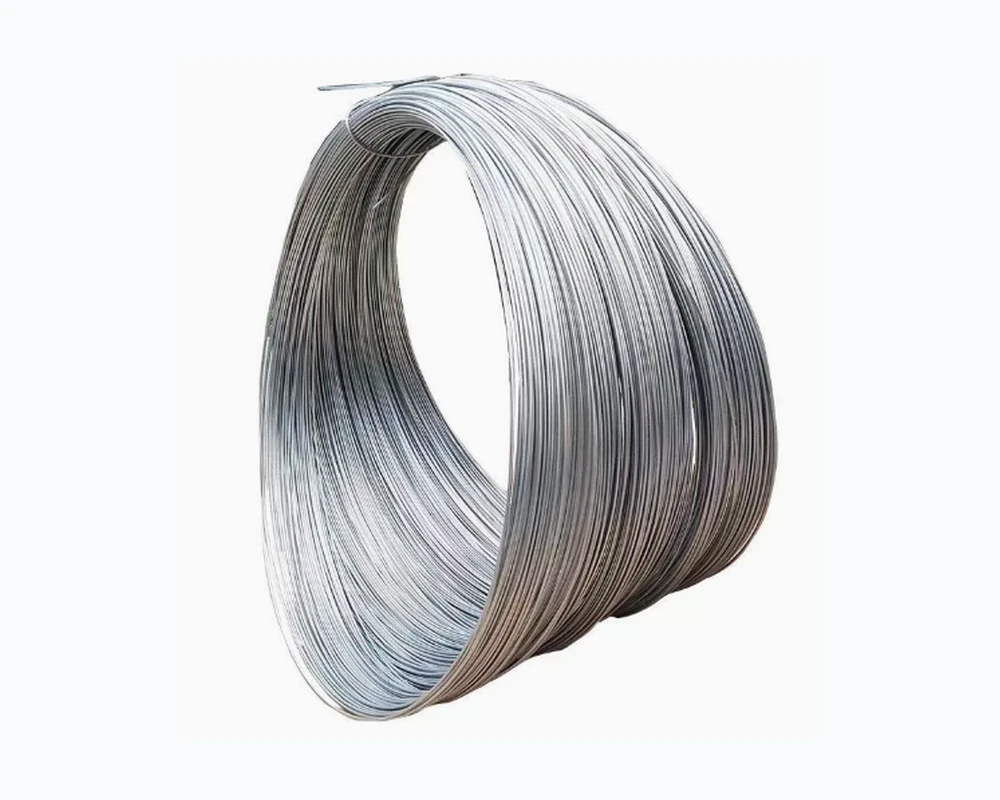
The supplier explained that the wire was old stock held since the previous year. The supplier stated that it remained in good condition and had no visible rust. This explanation changed the comparison: the lower quotation was not necessarily a lower production price for equivalent new production; it was a discounted inventory offer with a different stock condition.
| Supplier quotation | Price per ton | Total using the 28-ton case assumption | Difference from the lowest offer |
|---|---|---|---|
| Supplier A | USD 644 | USD 18,032 | USD 3,472 higher |
| Supplier B | USD 720 | USD 20,160 | USD 5,600 higher |
| Supplier C — declared old stock | USD 520 | USD 14,560 | Lowest quoted total |
A buyer might accept the old stock if samples and inspection confirm the required diameter, coating, mechanical properties, surface condition, coil weight and packaging. Another buyer may require new production because of end-customer rules, expected storage time, appearance requirements or internal quality policy. Both decisions can be reasonable when the condition is disclosed and evaluated.
- Verify production date, storage history and remaining quantity from one consistent batch
- Inspect for red rust, white oxidation, staining, coating damage and moisture exposure
- Confirm actual wire diameter, tolerance, zinc-coating requirement, tensile properties and coil weight
- Check winding, deformation, brittleness, packaging and suitability for the intended process
- Record whether old stock is accepted, conditionally accepted or prohibited in the purchase document
Normalize quantity, unit price, weight, dimensions and tolerances
Supplier quote comparison becomes unreliable when suppliers use different units or calculate prices from different quantities. Convert every offer to the same commercial and technical basis before ranking it.
- Currency and exchange-rate date used for the internal comparison
- Unit of measurement: piece, set, metre, kilogram, ton, square metre, carton or another basis
- Quantity used for the price and any MOQ or price-break condition
- Actual quantity supplied when production units, coil lengths or bundle sizes create an overage
- Net weight, gross weight and weight per unit where material content affects value
- Dimensions, thickness and tolerances rather than nominal size alone
- Included pieces per set, accessories, fittings, spare parts or consumables
- Tax inclusion, quotation validity and conditions that may change the price
A price per set may include different accessories. A price per ton may hide different coating levels or tolerances. A price per metre may represent different wall thicknesses and weights. The comparison sheet should show both the supplier’s original unit and the buyer’s normalized unit.
Compare packaging, accessories and one-time project costs
Packaging and included scope can change both product cost and shipping cost. “Standard export packing” is not a complete specification. Ask for the unit pack, inner quantity, carton or bundle dimensions, gross weight, pallet arrangement, moisture protection, labels and replacement responsibility for transit damage.
| One-time or project cost | Recurring order cost or included scope |
|---|---|
| Moulds, dies, fixtures and tooling | Product unit price |
| Engineering, design, software or prototype work | Custom material or component cost |
| Initial samples and development rounds | Printed packaging, labels and manuals |
| Printing plates, cylinders or setup | Testing, inspection or batch documents charged per order |
| Initial certification or laboratory work | Domestic delivery, export handling and loading |
| Artwork preparation or translation | Accessories, spare parts and consumables supplied with each order |
The quotation should state ownership, storage, maintenance and refundability of tooling. Paying a tooling charge does not automatically give the buyer ownership or the right to transfer it to another manufacturer.
Compare EXW, FOB, CIF and other delivery assumptions correctly
A price quoted EXW cannot be compared directly with a price quoted FOB or CIF. The selected Incoterms® rule and named place identify important delivery, cost and risk responsibilities, but they do not replace a complete sales contract or determine product quality, payment timing or regulatory compliance.
| Quotation field | What to confirm |
|---|---|
| Rule and edition | For example, FCA Shanghai warehouse Incoterms® 2020 or FOB Shanghai Incoterms® 2020 |
| Named place or port | The exact factory, warehouse, terminal, port or destination point |
| Origin transport | Whether pickup, domestic delivery and export handling are included |
| Freight and insurance | Whether the amount is included, estimated, current and based on the correct shipment volume |
| Destination charges | Which charges remain payable by the buyer after arrival |
| Packing and loading | Carton, pallet or container-loading assumptions and any special loading cost |
For bulky, fragile or low-value products, a small factory-price advantage can disappear after packaging and freight are normalized. Ask for carton dimensions, gross weight, shipment volume and loading quantity before choosing the supplier.
Official trade-term reference: ICC Incoterms® rules
Evaluate payment terms, lead time and production capacity
A cheaper offer can create greater financial exposure when it requires a larger deposit, an earlier balance payment or payment before inspection. Compare the deposit, balance trigger, payment method, currency, bank charges and separate payments for samples, tooling, testing or freight.
Lead time must also have a defined starting point. “30 days” may mean 30 days after deposit, sample approval, final artwork, material arrival or tooling completion. Separate sample, tooling, material, production, packing and document preparation time.
- Deposit amount and documented condition for starting production
- Balance timing: before shipment, after inspection, against documents or another milestone
- Current production schedule and realistic daily or monthly capacity
- Critical material or component lead times
- Peak-season effect and contingency for delay
- Date when goods will be fully packed and ready for inspection or shipment
- Correction, refund or replacement procedure if the agreed specification cannot be achieved
Compare standards, documents, quality controls and after-sales support
A certificate logo on a quotation is not enough. Ask for the actual document and check the manufacturer, model, standard, laboratory, tested voltage or material configuration and whether customization changes the document’s relevance.
- Applicable product standard and exact model or construction covered
- Test reports, certificates, declarations, labels and manuals required for the destination market
- Incoming-material, in-process and final checks relevant to the product
- Approved sample, drawing, tolerance table and acceptance criteria
- Pre-shipment inspection scope and responsibility for corrective action
- Warranty duration, covered parts, exclusions and replacement procedure
- Technical support, installation, training, spare parts and response time
- Approval requirement before any material, component, packaging or process change
A quality-management certificate can provide information about a company’s management system, but it does not prove that one specific shipment matches the buyer’s specification. Product requirements, sample approval and shipment-level quality follow-up remain necessary.
Quality-management reference: ISO 9000 family — Quality management
Calculate total comparable cost—not only factory price
The objective is not to force every unknown cost into one precise number. It is to identify which costs are included, excluded, estimated or still unknown so that the quotation comparison is transparent.
| Cost category | Examples to include or flag |
|---|---|
| Product and customization | Unit price, custom materials, branding, components and accessories |
| Development | Samples, moulds, tooling, engineering, artwork and testing |
| Quality and documents | Inspection, laboratory work, certificates and batch documentation |
| Origin logistics | Pickup, domestic transport, export handling, loading and special packing |
| International transport | Freight, insurance and surcharges based on the current shipment assumptions |
| Destination and operation | Destination charges, customs-related costs, local delivery, installation, training, consumables, maintenance and spare parts |
Duties, taxes and destination charges can depend on current local rules, classification and importer circumstances. Record them as estimates or obtain advice from the relevant customs broker or authority rather than inserting an unsupported percentage.
Use a supplier quotation comparison matrix
A supplier comparison matrix—also called a vendor comparison matrix or quotation comparison sheet—places every offer into the same structure. Missing information should remain visibly blank until the supplier answers; do not fill gaps with assumptions.
| Matrix field | Supplier A | Supplier B | Supplier C |
|---|---|---|---|
| Specification match | Compliant / alternative / unclear | Compliant / alternative / unclear | Compliant / alternative / unclear |
| Material and construction | Grade, composition, weight | Grade, composition, weight | Grade, composition, weight |
| Unit basis and quantity | Original and normalized unit | Original and normalized unit | Original and normalized unit |
| Price and included scope | Unit price plus inclusions | Unit price plus inclusions | Unit price plus inclusions |
| Stock condition | New production / declared stock | New production / declared stock | New production / declared stock |
| Packaging and loading | Method, dimensions, volume | Method, dimensions, volume | Method, dimensions, volume |
| Payment and lead time | Milestones and defined start | Milestones and defined start | Milestones and defined start |
| Delivery term | Rule, named place, exclusions | Rule, named place, exclusions | Rule, named place, exclusions |
| Quality and documents | Tests, inspection, certificates | Tests, inspection, certificates | Tests, inspection, certificates |
| Risk and unanswered questions | Evidence-based notes | Evidence-based notes | Evidence-based notes |
| Adjusted comparable cost | Calculated total | Calculated total | Calculated total |
| Decision status | Shortlist / clarify / reject | Shortlist / clarify / reject | Shortlist / clarify / reject |
For complex projects, add weighted scoring. Specification match and sample quality may carry more weight than price for safety-related or customized products, while a simple commodity order may place more weight on cost, packaging and delivery.
How to investigate an unusually low supplier quotation
A low quotation should trigger structured clarification, not an accusation. The supplier may have a genuine advantage: available material, efficient production, unused capacity, existing tooling, lower overhead, an inventory opportunity or a commercial reason to enter a market. The buyer’s task is to identify the cause and decide whether it changes product equivalence or risk.
- Confirm that the product, material, construction, dimensions, weight and performance match the controlled specification.
- Ask the supplier to list every exclusion, assumption and optional item.
- Check whether the price is based on old stock, excess inventory, mixed batches or a limited quantity.
- Confirm packaging, accessories, testing, documents, domestic transport and delivery term.
- Request a sample, drawing, bill of materials or cross-section where the difference cannot be explained from the quotation.
- Verify the supplier’s role, production location and which processes are completed internally.
- Record the clarification in the revised quotation or purchase document before payment.
Questions to ask suppliers and quotation red flags
Questions to ask before choosing a quotation
- Does this quotation follow the exact specification and reference sample?
- Which material grade, construction, thickness, weight and principal components are included?
- Is the offer new production, available stock or a declared alternative?
- What is included in the unit price and what is excluded?
- Which quantity, unit basis, packaging and loading assumptions were used?
- What one-time charges, samples, tooling, testing or documents are separate?
- Which Incoterms® rule and named place apply?
- When does the lead time start and when will goods be ready for inspection?
- Which quality checks, certificates, reports, warranty and corrective actions are included?
- What could cause the price or delivery date to change after order confirmation?
Quotation warning signs
- Generic product description without a model, drawing or attached specification
- Very low price with missing material, weight, grade, component or stock-condition information
- Packaging, accessories or spare parts described only as “standard”
- No named place with the delivery term
- Lead time with no defined starting point
- Certificates that cannot be matched to the offered manufacturer or model
- Tooling, sample or development charges hidden inside an unexplained total
- Important corrections agreed verbally but not added to the revised quotation
- Pressure to pay before specification, sample, company and bank details are verified
A practical final decision method
The best quotation is the offer that provides the strongest combination of specification match, transparent scope, acceptable total cost, realistic delivery, quality control and manageable commercial risk. It is not automatically the lowest number in the unit-price column.
Keep a written record of why the selected supplier was chosen and which conditions remain open. This record supports sample approval, purchase confirmation, quality follow-up and later repeat-order comparison.
How Giant Gateway supports supplier quotation comparison
Giant Gateway supports international buyers with product request support, requirement organization, quotation support, specification comparison, purchase coordination, sample follow-up, quality follow-up, packaging follow-up, documentation follow-up, shipment coordination and international trade support.
The objective is to help buyers identify differences hidden behind the headline price, compare offers on a consistent basis and carry the selected requirements into samples, purchase documents and pre-shipment follow-up.
Frequently Asked Questions
Supplier quotation comparison is the process of placing several offers on the same specification, quantity, unit, packaging, delivery and service basis so the buyer can compare total value and risk—not only displayed unit prices.
No. The lowest quotation may reflect a different material, construction, weight, stock age, packaging, delivery term or service scope. Confirm that the offers are equivalent before deciding.
There is no fixed number. Three or more relevant offers often help reveal a working price range and unusual outliers, but quotation quality and specification match matter more than collecting many incomplete prices.
Transfer every offer into one supplier comparison matrix using the same fields. Keep missing information blank and request clarification rather than guessing.
It should identify the product and specification, material or construction, quantity, unit basis, unit price, packaging, lead time, payment terms, delivery term and named place, validity, warranty, important documents and exclusions.
They may be quoting different grades, materials, dimensions, weights, components, stock conditions, packaging or commercial scope. The product name alone rarely proves that the offers are like for like.
No. A supplier may have efficient production, available material, unused capacity, existing tooling or discounted inventory. The buyer should identify the reason and verify whether it changes specification, condition or risk.
No. Old stock may be acceptable when its age and condition are disclosed and inspection confirms the required specification. Buyers who require new production should state that clearly in the request and purchase document.
Confirm the exact Incoterms® rule, named place, origin transport, export handling, freight, insurance and destination exclusions. Convert the offers to the same delivery basis before comparing their total cost.
They should be shown clearly, usually as separate one-time or development costs, so the buyer can distinguish initial investment from recurring production cost and confirm ownership or refundability.
Request samples when material, construction, performance or appearance cannot be confirmed from documents alone. Plan inspection according to product risk, order value, customization and the agreed acceptance criteria.
It is a structured quotation comparison sheet that records the same specification, price, payment, delivery, quality, document and risk fields for every supplier. It makes missing information and non-equivalent offers visible.
Check the manufacturer, exact model or construction, applicable standard, laboratory, tested configuration, date and whether customization requires additional testing or documentation.
Need help comparing supplier quotations?
Send Giant Gateway the product specification, quantities, quotation files and destination details for product request support, quotation support, purchase coordination, quality follow-up and shipment coordination.
Request Your Order